.png)
Coastal Film Festival Programme
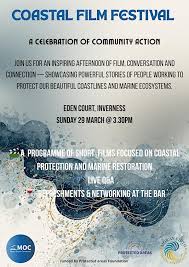
Coastal Film Festival
Film Summaries
● Moray Ocean Community
A celebration of Moray Ocean Community – a volunteer group passionate about exploring, protecting, and celebrating the amazing Moray Firth coastline. They bring people together through fun activities, citizen science,and community projects, helping everyone connect with and care for their local marine environment.
● Mossy Earth/Wilder Firths
The intertidal seagrass meadows around the coastline of the Black Isle support an incredible amount of life from over wintering birds to pipefish. But these meadows lack long term monitoring, and have faced huge declines around the UK. So, we've taken on the challenge of planting 4.2 hectares of seagrass meadow, supported by the Scottish Marine Environmental Enhancement Fund, to try and make our Firths a little wilder.
● Protected Areas Foundation
In their own words, the members of the Protected Areas Foundation talk about what drove them to be a part of the charity; the promise of MPAs in sustainable environments and economies; and just how vital local communities are in keeping oceans healthy.
● Ullapool Sea Savers
A film by the Ullapool Sea Savers about the work they do to protect and promote the Wester Ross Marine Protected Area and why they do it.
● Seachangers/GB Row
In June 2024, six women leaders in nature and climate set off from London in an attempt to row around Great Britain—gathering critical data on ocean biodiversity, temperature fluctuations and pollution. After a dramatic rescue forces them to abandon their vessel, the team take their mission to land, traveling the UK to meet grassroots conservationists restoring coastal ecosystems. Their journey is transformative, proving that real change ispossible, and that it begins with community-driven action.
● Revive our Ocean – Gokava Bay
This 7 minute film tells the story of reviving the waters of one of the Mediterranean’s most overfished seas: Turkeys Gökava Bay. Through grassroots collaboration among scientists, policy makers, conservationists and local fishers, no-take marine protected areas (MPAs) were established and destructive fishing practices eliminated. What followed was extraordinary- Gökava Bay went from fisheries collapse to remarkable recovery, with thriving marine life and a 300% increase in fisher income in four years. Through the voices of the featured local leaders, this film captures a powerful story of ecological rebirth driven by the people whose livelihoods depend onhealthy marine ecosystems. Today, Gökava Bay stands as a global reference for how coastal communities can reverse environmental devastation and rebuild thriving local economies through marine protection – proving that what’s good for the ocean is good for people.
● Our Seas/Seaful - A Line in the Sound
A Line in the Sound is a new short film created by Seaful in support of the Our Seas Coalition's campaign calling for at least 30% of Scotland’s inshore waters to be protected from trawling and dredging. It explores the lasting impact of fisheries management decisions on Scotland’s inshore waters and begins by revisiting the removal of the historic three-mile limit in 1984, a change made following pressurefrom the fishing industry that opened previously protected inshore areas to trawling and dredging.Through the personal account of a local scallop diver, the film documents the profound changes this decision triggered. He reflects on devastating declines in seabed health and fish stocks, contrasting today’s depleted environment with stories passed down through generations of a once-flourishing seabed rich in life and opportunity.The film then examines Marine Protected Areas (MPAs) in Scotland’s inshore waters.While MPAs are often cited as protecting 37% of these waters, the film reveals that only around 5% is fully protected from the most damaging fishing practices - trawling and dredging. The title, A Line in the Sound, refers to the Loch Sunart to the Sound of Jura Marine Protected Area where a clear boundary exists in the sound of Mull: one side prohibits trawling and dredging, while the other allows it, starkly illustrating how different levels of protection lead to very different outcomes for the marine environment.Finally, the film turns to hope and solutions, highlighting active restoration efforts. By returning native scallops to the seabed, diverse habitats can be rebuilt, supporting awide range of marine species and demonstrating nature’s ability to recover when given adequate protection.
● Anthony Rigello Untangled Seas.
This short film offers a glimpse into the marine diversity of Scotland’s west coast, specifically around the Isle of Skye. The films focus is on the whales that inhabit these waters. Through the story of two juvenile humpback whales that became entangled in early 2024, it highlights the challenges whales face and the collaborative efforts underway to reduce entanglement risk. Scotland’s seas support remarkable marine biodiversity, yet many people remain unaware of what exists just beyond our shores. Growing up, I had little understanding of the diversity of marine life around Scotland. By sharing this film, I hope to highlight how special these waters are and encourage greater awareness and consideration for the protection of thespecies and habitats they support.
● NatureScot/MOC
This film showcases Moray Ocean Communities use of the Community Led Marine Biodiversity Monitoring Project which was created to help facilitate Scottish community groups with an interest in their local environment to survey marine species and habitats and monitor how these are changing over time. Community group data collection is an important part of a national effort to better understand our inshore waters and therefore make better decisions about how we manage and protect our seas. Community group data collection also helps further a connection to the local area, build relationships, upskill and provide new learning opportunities and increase collaboration across different areas and sectors. It’s also fun!The work of the Moray Ocean Community is an example of the above-mentioned aspects.
.jpg)